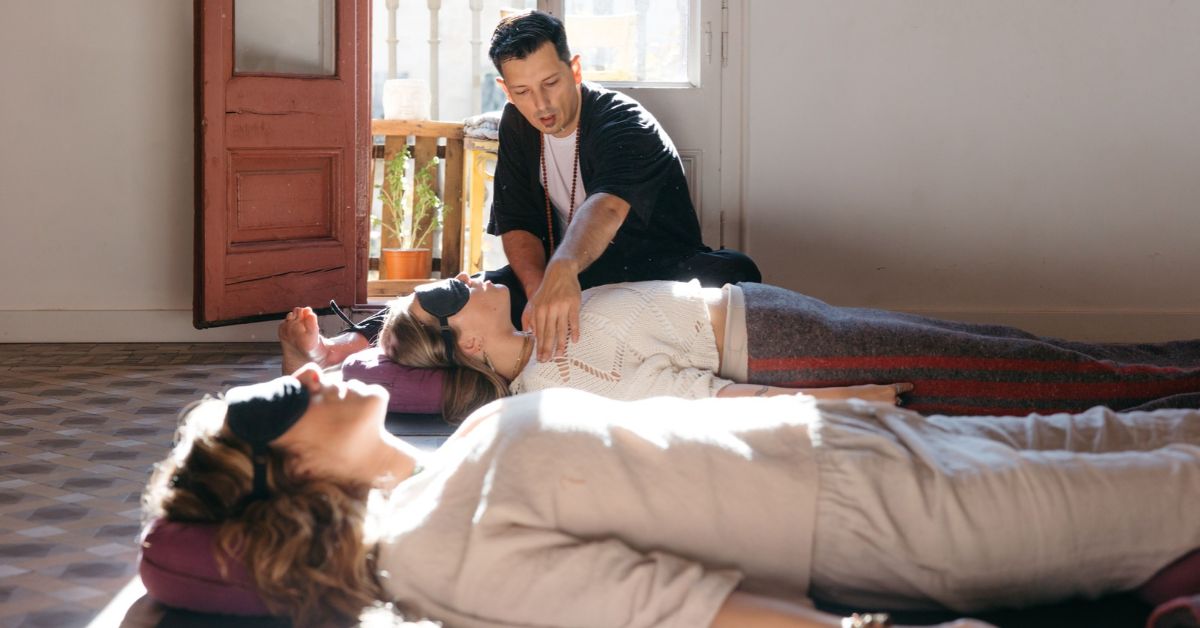
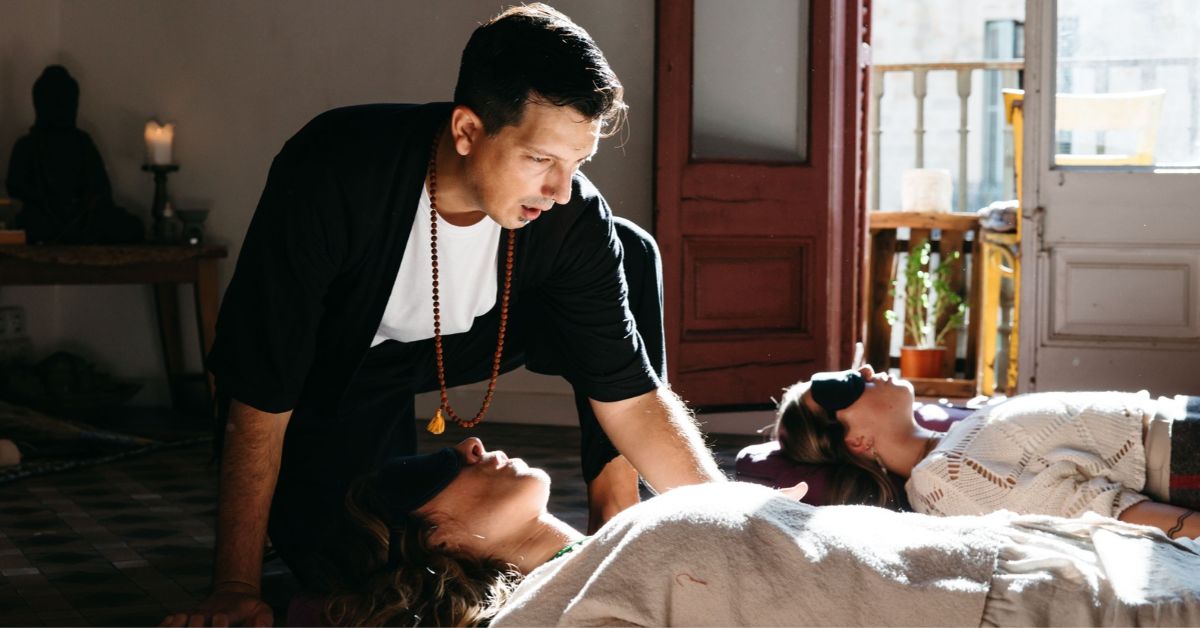
Holotropic breathwork, also known as transpersonal breathwork, is a method that combines breathing, music and support to enter expanded states of consciousness. It was developed by Stanislav and Christina Grof out of their research with psychedelics, and its full name, Holotropic Breathwork®, is a registered trademark. It is one of the best-known references in breathwork.
I’m Gonzalo and I guide sessions in Barcelona and online. What I offer is a holotropic-style breathwork: connected breathing, music, body and a space to integrate what you lived, adapted to other formats such as workshops and private sessions. In this guide I tell you where it comes from, what a session looks like and what I carry from that spirit into my work.
What is holotropic breathwork? (also known as transpersonal breathwork)
According to the organization that continues the Grofs’ work, the method is defined by a set of elements and an underlying philosophy, which they call the holotropic perspective. Breathing is only one part of it: reducing it to “breathing fast” falls short.
It is usually done in a group, lying on a mat with your eyes closed, to evocative music. People work in pairs and take turns: one breathes (the breather) and the other supports (the sitter). The sitter is simply present and available, without guiding or intervening. Afterwards there is usually a time for drawing mandalas and sharing, to integrate the experience.
Where it comes from: Stanislav Grof and psychedelic research
Stanislav Grof is a Czech psychiatrist who, during the 1960s, was principal investigator in a psychedelic research program in Prague, and later worked in the United States, in Maryland, at Johns Hopkins and at the Esalen Institute. When LSD was criminalized, he and Christina Grof looked for a substance-free way to reach those states: accelerated breathing, powerful music and bodywork (source: MAPS). The name, holotropic, is usually translated as “moving toward wholeness”.
That root in transpersonal psychology is why I also call it transpersonal breathwork: it puts the focus on a wider experience of yourself, with the body as the way in.
What a holotropic breathwork session looks like
- Preparation: the process is explained and we check whether it is right for you.
- Breathing session: about three hours, with music and support.
- Integration: mandalas and structured sharing, to make sense of the experience.
That is the format of the original method. I bring it into other formats, and below I tell you which ones.
Holotropic breathwork and connected breathwork: what they share and where they differ
Both use continuous breathing to reach different states of consciousness, which is why they get mixed up. Here is what changes:
- The structure. Holotropic breathwork has a defined format: breather and sitter pairs, mandalas and sharing. In connected breathing, the format and length depend on who guides it.
- The underlying philosophy. Holotropic breathwork rests on Stanislav Grof’s theoretical framework of the psyche. Connected breathing has no single framework.
- The name. Holotropic Breathwork® is the registered name of the original method. That is why, when I talk about what I offer, I say holotropic-style or transpersonal breathwork.
If you want to know the base practice behind my work, I explain it in my guide on what breathwork is.
A common mistake: calling any fast breathing “holotropic”
It is very common for any accelerated breathing session to be advertised as holotropic, and not all breathwork is. The original method is not just fast breathing: it depends on its whole structure, with sessions of about three hours, dedicated sitters, mandalas, sharing and an underlying philosophy. A single breathing exercise inside a class, or a short activity at an event, can be valuable in itself, and it is something else.
If you are looking for a session, ask how long it lasts, who supports you, what screening happens beforehand and how it is integrated afterwards. That is the root my work grows from. The format and the way I guide it are mine.
What we know about its effects
There are studies on conscious breathing in general that show promising results on stress, and I go over them in my previous guide. On holotropic breathwork specifically, the research is more limited and the mechanisms are not well explained. That is why I don’t promise results: many people describe intense experiences and greater clarity, but every process is personal.
Contraindications and safety
Intense breathing practices are not recommended, or call for talking to a professional first, if you have:
- Cardiovascular problems or uncontrolled high blood pressure
- Epilepsy or a history of seizures
- Pregnancy
- Glaucoma or retinal detachment
- A recent emotional or psychiatric crisis, or a diagnosis of psychosis or bipolar disorder
These lists vary depending on who guides the session, and they don’t replace your doctor’s opinion. If you have doubts about your case, check with them first.
Holotropic-style breathwork workshop in Barcelona
My breathwork workshop in Barcelona is a 3-hour format in total: movement, connected breathing with music and a closing circle. It is the best way to start, in a group and with support.
The holotropic or transpersonal style is a separate format, a full day: you work in pairs, one person breathes in the morning and the other in the afternoon, and at the end there is time for integration. If you’re interested, write to me and I’ll tell you more.
If you prefer work tailored to you, you can book a private online breathwork session or a private session in Barcelona.